
Trace Owsley County Former Owners Through Time
There is no master roll of former owners in Owsley County. Past ownership gets rebuilt transfer by transfer. Start with the newest deed that names your tract, then chase each source-of-title reference back one step at a time. The era decides which source carries the work. Electronic access runs through the County Clerk's eCCLIX system. The clerk does not publish its earliest indexed year. The archival record is clearer on limits. Kentucky Department for Libraries and Archives holds deed microfilm covering 1929 through 2003, plus selected tax books starting in 1844.
| Source | Years It Covers | Where Held | What It Shows |
|---|---|---|---|
| eCCLIX land-record index | Start year not published | Owsley County Clerk online route | Indexed parties, instrument references, and available images |
| KDLA deed microfilm | 1929-2003 | KDLA and clerk inquiry | Recorded transfers during the filmed span |
| KDLA tax books | Selected years, 1844-1955 | KDLA inventory | Taxpayer, acreage, and value clues in surviving volumes |
| Parent-county and state land files | Before 1843 | Clay, Estill, Breathitt, and state archives | Earlier tract history before Owsley County formed |
For recent transfers, check the Owsley County Clerk online-records page for current eCCLIX terms, then verify any index hit with the clerk directly. Older gaps call for the KDLA land-record inventory before you request a reel or volume. Tax books can bridge a missing name or year. But they never replace a recorded deed.
Build an Owsley County Deed-Chain Timeline
Give every transfer its own row on the worksheet. A chain crumbles when details get squeezed together. A correction, an estate conveyance, or a partial-tract deed deserves separate treatment rather than a vague note about an owner change. Read the source deed closely, because it may reserve timber, minerals, an easement, or an excepted tract even when the same family names appear on both sides of the table.
| Transfer Date | Grantor to Grantee | Deed Type | Book/Page or Instrument |
|---|---|---|---|
| Newest recorded date | Seller to current grantee | Read the exact instrument label | Copy the index reference |
| Prior recorded date | Earlier owner to later seller | Warranty, quitclaim, estate, or other | Follow the source-of-title citation |
| Earlier link | Repeat with name variants | Note corrections and partial tracts | Move to book or film when needed |
Keep the legal description beside the timeline. Names alone can join the wrong tract. Acreage, road calls, streams, adjoining owners, and prior book and page references anchor each transfer to the same piece of Owsley County land.
Owsley County Former-Owner Access Through eCCLIX
The clerk names Software Management LLC's eCCLIX as the online land-record route. Its terms divide users into two camps. A private user is limited to Owsley County. The user must have no commercial gain. Such an account may run up to five free searches a day. Commercial use requires a subscription. The office page does not display the live search fields, the earliest indexed year, or a sample result. Confirm those details with the clerk before starting a long search. The clerk's eCCLIX access page shows the current entry route and recording guidance.
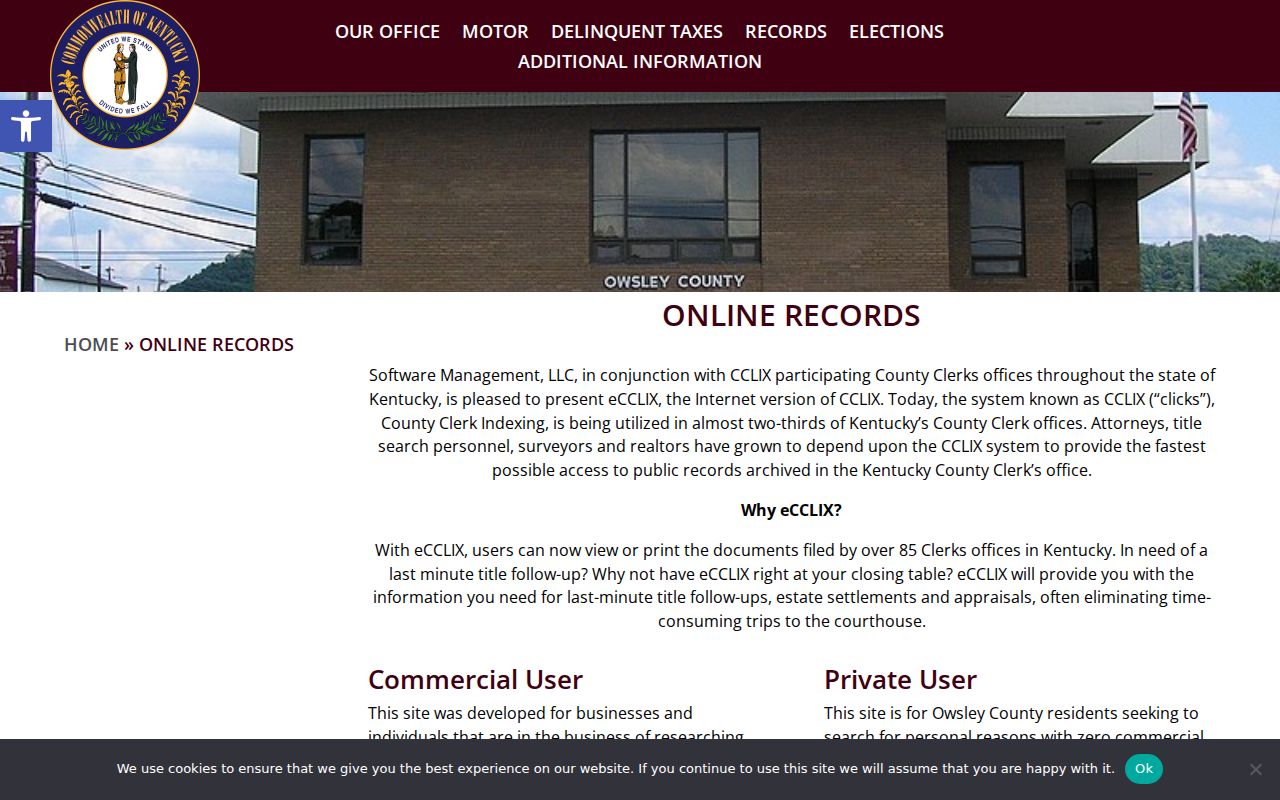
Treat the page as a doorway. It is not proof that every Owsley County former owner or historic deed image sits online. Save your query spelling, date range, result row, and any clerk answer about older books. Those notes keep a stalled search from starting over.
Note: Daily search limits reward a planned list of exact names and date ranges over broad trial-and-error guessing.
Walk Owsley County Previous Owners Backward
Begin with the current recorded purchase. Do not guess about the oldest family on the land. The newest grantee becomes your next search name. That deed's grantor identifies the prior owner. Each older acquisition deed then hands you the next grantor. It also gives a source-of-title clue and the tract description that keeps the Owsley County chain tied together.
- Locate the most recent deed and verify that its legal description matches the subject land.
- Record its grantor, grantee, recording date, deed type, and every source-of-title reference.
- Search the grantor as an earlier grantee, including initials, spouses, estates, and exact entity names.
- Repeat until electronic results end, then carry the last citation into paper books or microfilm.
- Grantor and grantee
- The conveying party and receiving party named in an instrument.
- Chain of title
- The ordered run of documents that carried an interest through time.
- Reverse index
- An index organized by grantee, useful for finding when a prior owner acquired land.
- Quitclaim and warranty
- Different deed forms whose legal effect must be read in the instrument, not guessed from the index.
The 1929 Owsley County Ownership Gap
Owsley County's 1887 brick courthouse burned in January 1929. KDLA also records a courthouse disaster in 1967. The deed microfilm run starts in 1929, so that year marks a crucial handoff in any former-owner search. Records were clearly damaged or lost. But the sources do not support claiming that every deed before the fire vanished.
Coverage limit. The earliest eCCLIX year is not published. KDLA deed microfilm spans 1929-2003, so ask the clerk where an older chain continues.
When a link in the chain breaks, other Owsley County records can close the gap. Later deeds often recite an older source of title. Surviving tax books, wills, court orders, state grants, and surveys all help too. So do parent-county deeds, newspapers, family papers, and adjoining owners' deeds. The KDLA courthouse-disaster page supplies the official event marker. Even so, the missing categories and their extent still require an office-level check.
Use Owsley County Tax Books as a Parallel Index
Surviving assessment books can place a taxpayer, tract, acreage, or value in a year. They help when the deed chain turns murky. KDLA lists Owsley County tax books for 1844-1875, 1879-1892, 1929-1931, 1933-1937, 1939-1949, 1951-1952, 1955, and some undated material. Those broken spans show what survived, not a complete annual series. A name change on the tax roll is only a clue. It may reflect estate administration, delayed assessment work, or an exemption. It could also be a taxpayer who never held title at all. Compare each shift against a deed, will, probate file, or court order. Only then does the person belong in the verified chain of property records.
Estate Transfers Among Owsley County Prior Owners
A former owner can vanish from the deed index for a simple reason. Land often passed through probate. It may have moved by affidavit of descent, commissioner's deed, or another fiduciary instrument. KDLA's inventory lists Owsley County wills from 1930 through 2001. When a deed names an estate, executor, administrator, or case, start the court search with the Owsley Circuit Court Clerk. That office holds the probate files.
Record the decedent first. Note the fiduciary, the heirs or devisees, and the property description. Add the case number, the order date, and any later deed. Vital records can corroborate an event. A death certificate alone does not transfer title. The estate instrument or court order must connect the deceased owner of record to the next recorded interest. It has to name that next interest too.
Note: Search the deceased person's name and the estate or fiduciary wording in the deed or probate index.
Match Old Owsley County Deeds Without an Address
Older Owsley County deeds rarely carry a street number. Instead, they describe land by calls, courses, distances, and acreage. They also name streams, roads, and adjoining owners. That makes patience part of any property search. Modern anchors still help you get oriented. Routes like KY 11, KY 28, and KY 30 appear throughout Owsley County deed records. So do Fish Creek Loop, Booneville Heights Road, and the South Fork Kentucky River. Just remember the labels on a current plat or GIS map may not match the wording in an old instrument.
Copy the legal description in full. That means every phrase starting with "beginning at," plus each exception and reserved right. Include each survey call and neighboring surname as well. A later deed often updates a road name. It may still repeat the old acreage or the citation to an earlier deed. For land that predates Owsley County's 1843 formation, keep going. Search the Clay, Estill, and Breathitt county records from that earlier period. Do that instead of forcing a modern Owsley index to answer questions it was never built for.
Verify an Owsley County Former-Owner Chain
A strong chain separates the index line from the recorded deed itself. Indexes point you to the instrument. The instrument holds the proof. For every former owner, record the party spelling exactly as written, the recording date, the book and page or instrument number, the deed type, the full legal description, and the consideration. Include any cited prior deed. Check corrections against the original. Treat nominal or gift consideration as context for the transfer, never as a market price.
Some situations demand more than your own reading of property records. A purchase, an estate, a boundary dispute, or an easement question changes the stakes. Ask the clerk for an image or certified copy. When the chain stays disputed, bring in professional title help. The mechanics of ordering full deed copies appear on the Owsley County deed records page. This workflow stays on reconstructing prior owners.
How Far Owsley County Ownership Records Reach
Owsley County formed in 1843 from Clay, Estill, and Breathitt counties. So the earliest land history may sit with those parent counties. Some of it may sit in state grants, surveys, and warrants. KDLA documents selected tax books beginning in 1844. Its deed microfilm runs from 1929 through 2003, and wills from 1930 through 2001. The county's online eCCLIX cutoff is not stated. These ranges describe documented holdings, not a promise of complete property records coverage.
Lawful use. Former-owner research supports house history, estate work, and property diligence. Never use the records to track, threaten, or harass a living person.