
Compare Owsley Deed Types
The document type is a first clue, not a legal conclusion. Owsley County records many kinds of land instruments. The County Clerk indexes deeds, correction deeds, easements, quitclaims, leases, mortgages, plats, powers of attorney, and releases, among others.
| Deed type | What it does | Common research use |
|---|---|---|
| Warranty deed | Conveys an interest with stated warranties and exceptions | Trace a purchase and reserved rights |
| Quitclaim deed | Transfers any interest held without a title guarantee | Resolve family or uncertain claims |
| Correction deed | Corrects the original with the same parties | Compare the changed field |
| Easement | Creates a defined use right | Study access, width, and maintenance |
Labels only go so far. Read the instrument's own language, because the title alone cannot reveal how much of the estate was conveyed or prove the grantor held good title.
Open Owsley eCCLIX Records
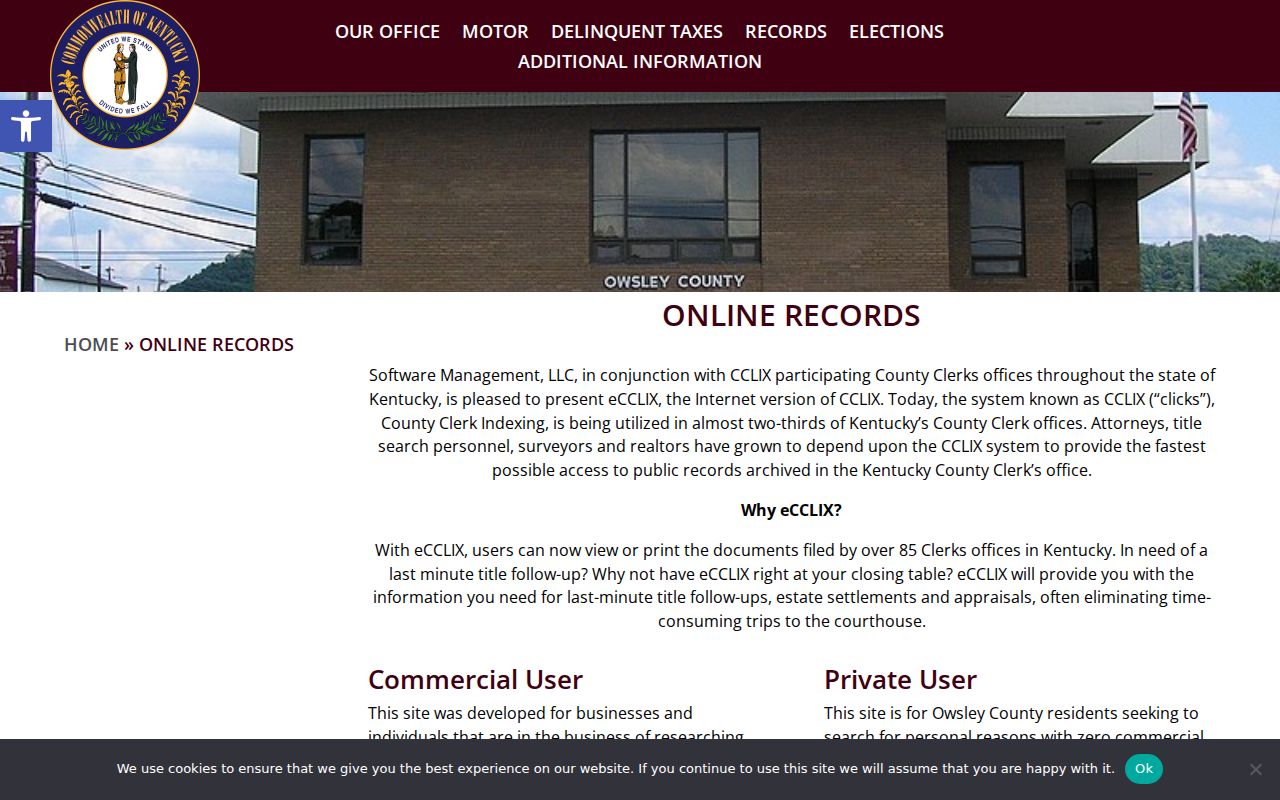
The clerk's eCCLIX access page is the online route into the records. Private users may search Owsley County only. They may not use it for commercial gain. Each gets up to five searches a day at no charge. Commercial users subscribe and can add counties. The page states that documents from participating counties may be viewed and printed. It does not display the live search fields. Nor does it list the earliest year available online, so plan the first session accordingly.
Search boxes and coverage dates should come from the portal itself, never assumption. Note the access date and the county selection you used. Portal changes can quietly alter a name search that once worked.
Trace Owsley Grantors Backward
Start with the newest known owner. Find that party listed as grantee, open the deed, and copy its source-of-title clause. Then search the prior owner it names, both as grantor and as grantee, working backward one transfer at a time.
- Record current deed date, parties, type, and book/page or instrument number.
- Copy the legal description and every prior deed or plat reference.
- Search the grantor's acquiring deed under spelling and entity variants.
- Repeat until the electronic index ends, then move offline.
- Grantor
- The party conveying an interest.
- Grantee
- The party receiving it.
- Chain of title
- The linked series of transfers for the same land.
- Book/page
- A recorded document locator, distinct from a parcel number.
Read an Owsley Deed Fully
A complete deed reading preserves the grantor and grantee. It also covers addresses, consideration, and the legal description. Add source of title, preparation statement, return address, and signature. The notary acknowledgment, recording date, and references finish the list. The clerk requires an in-care-of tax-bill address on all deeds recorded since August 1, 2008.
Kentucky transfer tax runs $0.50 per $500 of value or fraction. Gift and nominal-consideration transfers may need a sworn fair-cash-value certificate. Exceptions cover certain utility easements, divorce actions, and public rights-of-way. Cemetery lots, same-party correction deeds, and local airport-board transfers are exempt too. Consideration is transaction evidence. It is not a verified market appraisal.
Note: Search any easement under both parties. Check each parcel as well. Then record its location, width, purpose, maintenance terms, and attached plat.
Cross Owsley's 1929 Gap
Owsley County formed in 1843 from Clay, Estill, and Breathitt counties. Its 1887 brick courthouse burned in January 1929, and KDLA also lists a 1967 disaster. State research supports saying records were damaged or lost. It does not support claiming every older deed disappeared. The exact volumes, pages, and record classes affected still need confirmation. That confirmation should come from the clerk or archive. The KDLA land inventory covers Owsley deed microfilm from 1929 through 2003. Tax books survive in runs beginning in 1844. Wills cover 1930 through 2001. The FamilySearch catalog also returns Owsley land and tax holdings, though item access varies. When a chain breaks, check paper books, film, tax books, and probate. Also check later deed recitals, neighboring-owner deeds, court orders, and parent-county records. Build a year-by-year worksheet listing repository, record type, and parties. Add legal description, locator, image status, and gap reason. If no transfer appears, mark the chain incomplete. A later recital such as "heirs of" or a reference to a lost deed can point toward probate. It can also point toward court records or a replacement instrument. It never authorizes assuming an owner.
Coverage limit: The earliest eCCLIX year is not published in the inspected sources; move offline when the index ends instead of claiming no deed exists.
Request Owsley Deed Copies
The County Clerk sits at 20 Main Street, first floor of the courthouse, Booneville, with mail to P.O. Box 500, Booneville, KY 41314-0500 and phone 606-593-5735. Call before visiting. Confirm hours, book availability, copying rules, and current charges. For a large book or file, ask to inspect it first. KRS 64.012 lists $33 for the first five pages of a deed or similar instrument. Each added page costs $3, extra references $4. Certified copies run $5 plus $0.50 per page after the first three. Verify the total before ordering. KRS 64.019 allows security or preservation limits on cameras and scanners but protects handwritten notes.
Follow Owsley Encumbrance Records
Deed records also index interests that burden land. A mortgage or deed of trust should be traced through assignments and modifications. It should also be traced to a release or satisfaction. Record the borrower, lender or trustee, amount, legal description, and original recording reference. A later release should say whether it clears the whole instrument. It should also say whether it clears only part of the debt or land. Easements need a parallel check. Search both parties and each parcel. Then note the purpose, location, width, maintenance terms, and any attached plat. A missing release does not prove a debt remains valid. Classify each result as indexed, recorded, released, partly released, litigated, unresolved, or a gap. Do this until the documents support more. Note: Repeat the encumbrance search under each owner in the chain, because a current name alone can miss an older lien or easement.
Match Owsley Deeds to Parcels
An address is not a tax parcel. A deed tract and a mapped shape are not the same thing. Owsley County deeds often describe land by metes and bounds. Others use acreage, adjoining owners, a creek, or a public road. Some cite lot and block, a survey, or a prior deed. Copy every call and exception exactly. Then compare that legal description against the PVA identification record and any recorded plat.
An acreage mismatch is not always a mistake. A partial conveyance can explain it. So can a reserved tract, a road right-of-way, or rounding. A parcel split or a correction can too. Trace the parent deed and later splits. Do this whenever today's parcel came out of a larger tract. The Owsley parcel map page walks through the identification tools. Keep in mind that no map conveys title.
For a boundary or access dispute, contact a Kentucky-licensed surveyor. Hand over the full deed chain, plats, easements, and map. Get legal advice when title itself is in question.
Capture Owsley Deed Index Evidence
The eCCLIX search form displays no fixed set of labeled boxes, so work with the fields the portal presents rather than assumed ones. Once access works, save the full result row before opening any image. A good index capture keeps enough context to repeat the search and to tell this tract apart from another record involving the same party.
- Grantor and grantee names exactly as indexed
- Instrument type and recording date
- Book/page or instrument number
- Property description or parcel reference, if displayed
- Linked prior instrument or source-of-title reference
- Image status and certification option
Use entity and estate names exactly as the record gives them. If a business shows up, compare the precise legal name with the Kentucky Secretary of State file. That is an identity check only. The corporate filing does not prove title. For an estate, search the decedent, the fiduciary, and the heirs. Also search any deed or court order that completed the transfer.
A blank online result is a gap, not proof that no deed exists. Call the clerk. Use the courthouse index. Continue with KDLA or FamilySearch holdings. Give staff a tight date range and both party names. Include road or tract clues and the last known recording reference. Land predating Owsley County's 1843 formation may sit in Clay, Estill, or Breathitt parent-county records. Follow the deed trail wherever it leads.
Check Owsley Record Integrity
Kentucky Attorney General notices reported a 2024 indictment. It involved former Clerk Shanna Oliver. A plea and resignation followed. The official plea notice covers that event. Do not extend facts about a former officeholder to current Clerk Austin Bowling. Do not apply them to every county record either.
For a consequential title issue, get the instrument image or a certified copy. Confirm its index references. Log the request date, the query, and the response. Record the fee quote, the copy type, and every break still unresolved. Compare the clerk-confirmed copy against the index entry and the prior source reference. Note any difference. Hold off on saying which source is wrong until the clerk responds. This habit serves every chain well. It matters most when a portal changes.
Recorded is not guaranteed. Recording gives public notice, but an index hit or recorded instrument is not a legal opinion that title is clear.