
Check Owsley's Owner Record
The Owsley PVA qPublic page is the official place to begin a current-owner check. It offers live parcel lookup for the county. The PVA can confirm field labels, the card's data date, and how quickly a new deed appears. Call before relying on any single display.
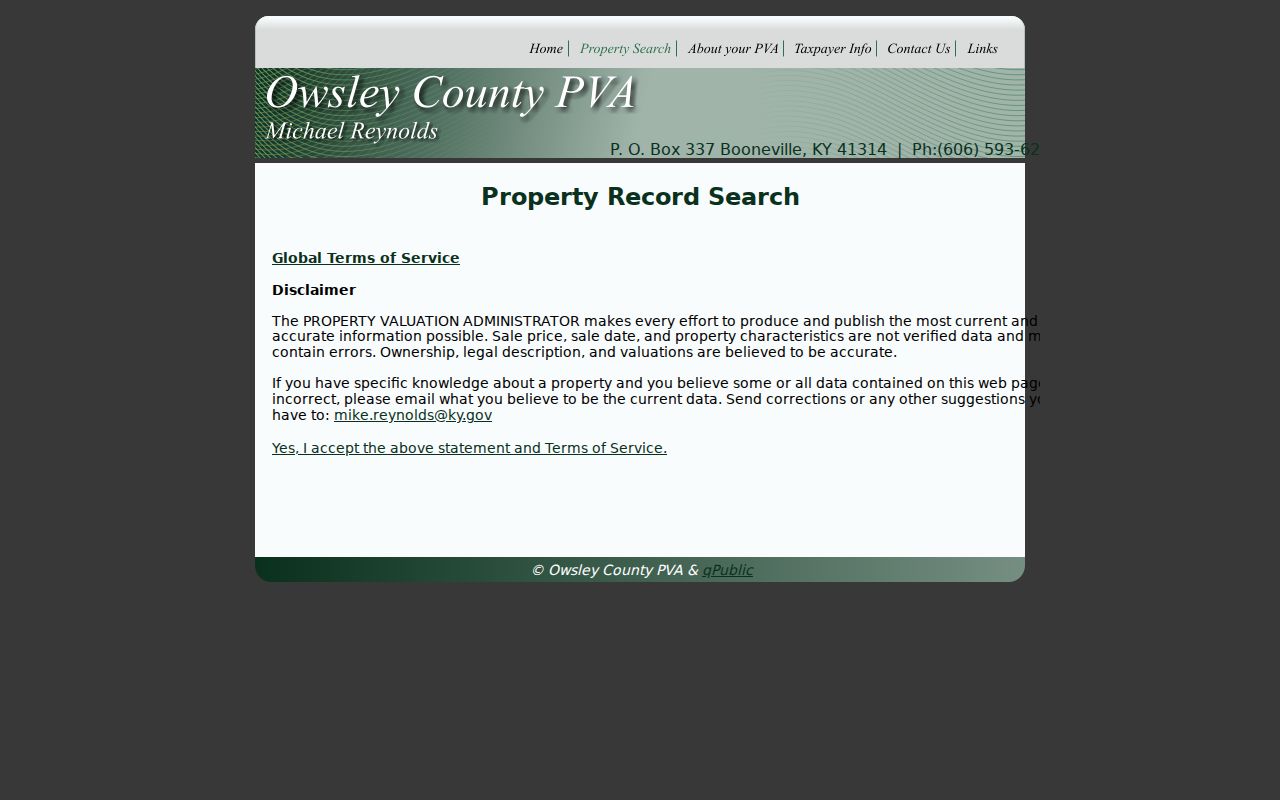
Owsley's PVA landing page marks exactly where the owner record lives. Field names and refresh timing still require a live result or confirmation from staff.
| Owner name | The name carried on the current assessment roll, once confirmed by the PVA |
|---|---|
| Mailing address | The destination for owner or tax correspondence, not proof of residence |
| Situs address | The location assigned to the assessed property |
| Parcel number | The administrative key tying the card to the mapped tract |
| Last sale | A date or price that the PVA warns may be unverified |
| Deed reference | The book, page, or instrument link to verify with the County Clerk |
The assessed owner is not always the occupant. Notices may go to a different mailing address, a company office, a fiduciary, or another authorized recipient. Treat the tax roll as a current administrative record. The latest recorded deed remains the best confirmation of who holds the conveyed interest.
Separate Owsley Owner Address Fields
Keep owner name, mailing address, and situs address on separate lines in any worksheet. The mailing field shows where notices go. Situs marks the land's assigned location. A Booneville mailing city with ZIP 41314 is a postal fact, not proof of municipal limits.
Rural parcels bring address quirks. Record route-name variants beside the parcel number. KY 11, KY 28, KY 30, Fish Creek Loop, Booneville Heights Road, and Twin Meadows Road can appear in several forms. If an address search misses, ask the PVA to search by road, deed description, or adjoining owner.
Note: Keep the source date beside every owner and address field so a later reader can judge how current it is.
Date the Owsley Assessment Roll
Kentucky property assessment uses January 1 as its assessment date. Property is listed annually. Real property is physically examined at least once in a four-year cycle under state guidance. Those rules say nothing about how quickly Owsley qPublic reflects a deed recorded after a closing. The local refresh cycle is set by the PVA and clerk. Ask them directly when timing matters.
Request the card's “as of” date and whether a recent transfer is pending. Compare it with the deed's execution and recording dates. A January roll can correctly show the assessed owner for that date. A later deed names the current grantee.
Keep four dates apart. These are the deed's execution date, its recording date, the PVA assessment date, and the date you consult any index. A probate order or court-directed transfer can add another gap between legal action and recording. If the systems disagree, report both names with their source dates. Do not call either record wrong until the PVA and clerk explain the sequence. Retain the parcel identifier on every copy. That way two similarly named owners are never merged by mistake.
Confirm Owsley's Current Owner
Confirming ownership moves from the assessment card to the newest deed. Match the parcel number exactly. Use the legal description and precise owner name so similar names or shared mailing addresses never blur two records together.
- Obtain the current parcel card from the PVA and record its date, owner name, mailing address, situs, and parcel number.
- Use the Owsley County Clerk online-record route or the counter to locate the latest deed for that tract.
- Match the grantee, legal description, recording date, and source-of-title reference. Check for corrections or later instruments.
- If an entity or estate appears, verify the exact public filing or probate authority without treating its contact person as the landowner.
- Owner of record
- The party named by an official record at its stated date.
- Assessment roll
- The PVA's record of assessed parcels, owners, and values for tax administration.
- Recording lag
- The interval between a deed's recording and a later update to another system.
- Registered agent
- A company's public recipient for legal notices, not necessarily the property owner.
Read Owsley Sale Fields Carefully
The Owsley PVA expressly warns that sale price and sale date may be unverified. Property characteristics may be unverified too. Treat a displayed sale row as a clue. Compare it against the recorded instrument, legal description, and transfer context before drawing conclusions.
Nominal consideration, gifts, and exempt transfers can each skew a sale field. Partial tracts and corrective documents can too. The deed's grantee decides ownership. Recording data backs it up, while assessment and sale displays serve their own administrative purposes.
Verify Owsley Entity Owners
An LLC or corporation needs one more step. Search the exact name in the Kentucky Secretary of State business database. A close match is not enough. Match the entity's public filing details to the deed, and never substitute an officer or registered agent for the grantee in the land record.
Trusts and estates take different evidence. The deed comes first, along with trust wording in the index, probate orders, and any fiduciary appointment. Affidavits and later distribution instruments can fill gaps. The Owsley Circuit Court Clerk holds probate files when current title depends on an estate proceeding.
Entity names change, dissolve, merge, or differ in punctuation across indexes, so preserve the spelling shown on the owner card and deed. Record the business filing number as a separate identifier. A UCC filing can hint at collateral but never replaces the county deed. A fiduciary's mailing address shows where notices go. It does not make that person the beneficial owner.
Correct an Owsley Owner Record
Document the mismatch before you request a fix. Give the PVA the parcel number, the current card, and the newest recorded deed reference. Include the date of each source. Ask what kind of problem it is. It could be ordinary processing lag, an address correction, or a split or merge. A deed issue may need the clerk to resolve it first.
The Kentucky Open Records Act opens existing public records to anyone. It does not force an office to build a new title conclusion. So request something concrete. Name the exact card, deed, or index entry. File the response and its source date with the parcel record.
Splits and partial transfers raise their own questions. Ask whether the parent parcel is still active. Ask whether the new tract carries a child or alternate identifier. Compare acreage and legal descriptions instead of trusting the street address. If the latest instrument is a correction deed, set it beside the original. The clerk's guidance says a correction uses the same grantor and grantee and conveys no new interest.
Note: A clerk-certified deed copy can authenticate the recorded instrument, but it is not a legal opinion that title has no defects.
Use Owsley Owner Data Lawfully
A mailing address in a public assessment record can anchor a property-related letter. Treat it as a mailing address, not the owner's home. Never append phone numbers, relatives, or commercial profiles to an official owner record. Kentucky Safe at Home can shield certain addresses.
When you write, name the parcel plainly. State your reason, whether it is a purchase inquiry, a boundary matter, an estate question, or a deed correction. If the record withholds an address, ask the custodian how lawful correspondence works. Do not try to defeat the protection. Keep the request tied to a real property issue.
Respect the record. A current owner name is for lawful property research. Never use it to stalk, harass, intimidate, or expose a protected address.